by Daniel Hathaway
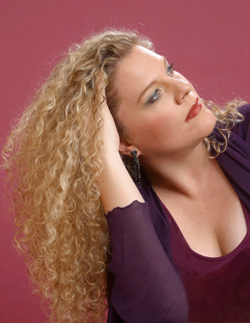
Mezzo-soprano Michelle DeYoung will return to Severance Hall this weekend to sing Gustav Mahler’s symphonic song cycle
Das Lied von der Erde with tenor Paul Groves, guest conductor Donald Runnicles, and The Cleveland Orchestra.
DeYoung’s previous appearances with the Orchestra have included Giuseppi Verdi’s
Requiem under Robert Porco in May 2012, and a concert honoring Pierre Boulez on his 90th birthday in January 2015, when she replaced Anne Schwanewilms in three excerpts from Alban Berg’s
Wozzeck. Another area appearance was in May 2011, when the Baldwin Wallace Art Song Festival presented DeYoung in a solo recital, the occasion for an extensive
interview published on
ClevelandClassical.com.
I spoke with Michelle DeYoung by telephone at her home in Evergreen, Colorado to chat about Mahler. I began by asking her about her recent activities.
Michelle De Young: I had an incredibly busy fall singing all over the place. I was in Melbourne for the second act of Parsifal, I went to Paris and Vienna for Bluebeard’s Castle, and to Brazil for the Verdi Requiem. When the second week of December got here, I was just exhausted, but it was all wonderful.
DH: This seems to be “Das Lied von der Erde” month for you. You’ll be singing it in Cleveland, then later with the Kansas City Symphony — where, interestingly, it’s also being paired with Schubert’s “Unfinished” Symphony.
MDY: It’s funny — the next couple of months are all Mahler and Bartók. I think Das Lied and Bluebeard are a bit odd following one another. I feel that the Bartók should come first, then the Mahler, but I didn’t plan it, so…
DH: There’s been a change of conductor for your performance of the Mahler here in Cleveland — Christoph von Dohnányi withdrew and is being replaced by Donald Runnicles. Have you worked with Runnicles before?
MDY: Yes. I really, really like him, and I was so happy when I heard. I like working with him personally, but I also admire his work in general. I think he’s top-notch, so it’s very exciting.
DH: Das Lied von der Erde is an enormous piece, a song cycle on a symphonic scale. The last movement, “Abschied,” is almost as long as the other five movements combined — and you have that long goodbye all to yourself. What does it feel like to sing this work?
MDY: That’s hard to put into words. It’s almost ethereal. That’s a cliché, but it really is. Just on a human level, it’s a huge honor to sing it. The journey that it takes you on is so wonderful. I’ve sung it throughout my career, and it’s interesting that the emotional journey you go on is so different every time, because it depends on what you’re actually going through yourself. I think Mahler gives us a huge gift — that we are allowed to go on that journey.
The last movement is definitely about eternity and farewells. Mahler is so good at text-painting. Everything is in the music and you just go along on this emotional ride. There are two sections to the “Abschied” from two different Chinese poems. The first one talks more about the earth and beauty. Sadness begins to creep in, but it’s not quite there yet. The second section really says, ‘I’m waiting for my friend for a final farewell.’ In working on it for these concerts, I was thinking about all the different journeys that I have been on. You have different experiences through it, which is such a gift for the singer — and hopefully a gift for the audience as well.
DH: Between those two sections of the ‘Farewell,’ there’s an extended orchestral interlude, one of Mahler’s famous funeral marches. What goes through your mind during that long stretch of music as you’re waiting to sing the final section?
MDY: I just allow it to take me wherever it’s going to take me. Again, with Mahler everything is in the music. There’s a point where you hear the footprints, you hear the owl, you hear a scary animal — you don’t have to think about anything. I don’t pre-plan how I’m going to sing the rest of the movement. Of course, every conductor is going to do it differently. I sang it recently with a conductor who took that section really fast. That isn’t how I would do it, but it was an interesting interpretation, and it gave me a different experience of what was happening.
DH: You recorded Das Lied in 1999 with Eiji Oue and the Minnesota Orchestra. How has your view or interpretation of the piece changed since that time?
MDY: I’ve grown up. That recording was almost 20 years ago, and I’m a different woman now. A lot of the emotions are different, but also the way that I react to the music and the way that I sing it. Although there would be a huge difference in my interpretation between then and now, the piece is also different from performance to performance.
DH: I’ve asked you about some of your past performances. Are there some roles or projects you’d like to try out or take on in the future that you haven’t explored yet?
MDY: I can tell you that I’m scheduled to sing Marie in Wozzeck, I just can’t tell you where! I’m very intrigued by Strauss’s Ariadne auf Naxos. It’s become the trend to use lyric voices for Ariadne. The role is more difficult than I had imagined, but I’d really like to try that. And I’m looking at some other roles that I’m not willing to put in print at this point! We’re talking, but there’s nothing scheduled yet.
Published on ClevelandClassical.com February 6, 2017.
Click here for a printable copy of this article

